Most homeowners think about wildfire and water damage as two separate disasters. One destroys with heat, the other with moisture. But the most destructive water damage events following a wildfire happen months after the last ember is out and they affect homeowners far beyond the fire zone itself.
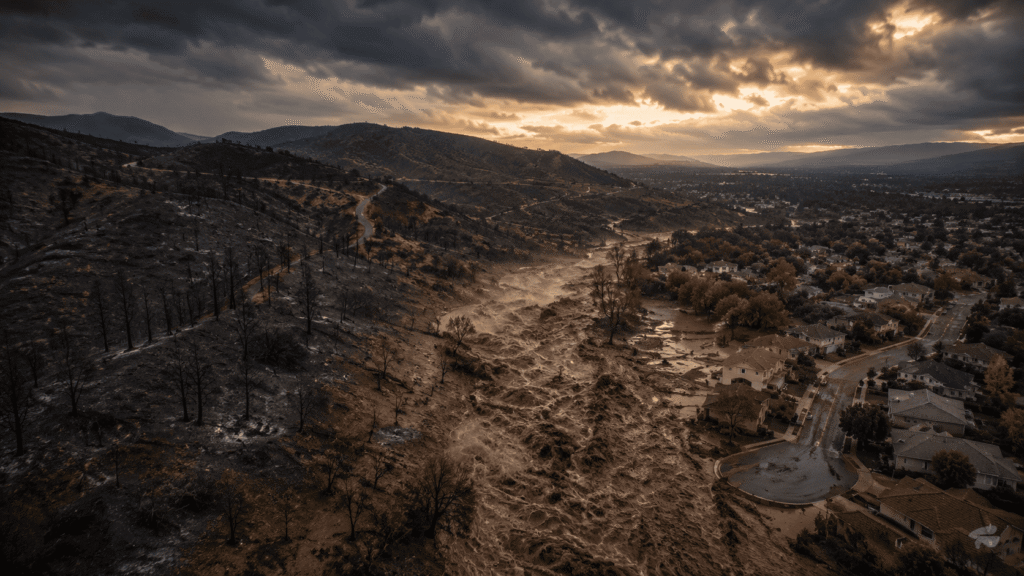
In California, we see it every year. A canyon burns in October. November brings rain. Suddenly, neighborhoods that never flooded are underwater not because of the storm, but because the fire changed everything about how that hillside absorbs water. Debris flows, ash contamination, hydrophobic soil, and compromised drainage infrastructure combine to create water intrusion events that are misclassified, mishandled, and consistently underestimated by homeowners and insurance adjusters alike.
What most people don’t realize is that the underlying mechanisms accelerated surface runoff, overwhelmed drainage systems, and accelerated foundation water intrusion are not exclusive to wildfire regions. From Ohio’s spring snowmelt overwhelming clay-heavy soil to hurricane flooding in the Southeast, the same physics drive water damage events across every US climate zone. Understanding the wildfire model illuminates the science of every high-volume water damage event.
This guide covers what actually happens at a molecular and structural level when fire and rain collide and what every homeowner, whether you’re in the Hollywood Hills or Akron, Ohio, needs to know before the next weather event tests your home’s defenses.
The science: how wildfire fundamentally changes how soil handles water
To understand why wildfires trigger flooding, you need to understand what fire does to soil not just the surface, but several inches beneath it.
When organic matter in forest soil burns, it vaporizes and moves downward through the soil column. As it cools a few inches below the surface, it recrystallizes into a waxy, water-repellent layer called a hydrophobic soil layer. According to research published by the US Geological Survey (USGS), this layer can reduce soil water infiltration by up to 40 times compared to unburned soil.
The practical implication: when rain falls on a burned hillside or landscape, almost none of it absorbs into the ground. It sheets off the surface picking up ash, charred debris, and sediment as it goes and runs directly toward the lowest point. Drainage channels, storm drains, creek beds, and home foundations become the terminal destination for what is now a Category 3 contaminated slurry, not clean rainwater.
Fire Science: The Hydrophobic Soil EffectHealthy soil absorbs 1.5–3 inches of rainfall per hour. Post-fire hydrophobic soil absorbs as little as 0.04 inches per hour meaning that in a 1-inch rainstorm, 96% of precipitation becomes immediate surface runoff. That’s not a flood. That’s a pressure wash aimed at your foundation.
The three compounds that contaminate post-fire water
Runoff from burned areas doesn’t just carry sediment. It carries a chemical mixture that the EPA classifies as a complex hazardous contamination stream containing:
- Polycyclic aromatic hydrocarbons (PAHs) — known carcinogens released from burned organic material and structures. These adhere to sediment particles and travel with runoff water.
- Heavy metals — lead, arsenic, chromium, and zinc released from burned structures (paint, treated lumber, roofing materials, appliances). These leach into runoff and persist in soil and groundwater.
- Ash alkalinity — wood ash produces a highly alkaline solution (pH 9–12) when dissolved in water. This alkaline contamination corrodes metals, degrades concrete, and creates an environment hostile to effective mold remediation if it enters a structure.
When this contaminated water enters a home through foundation cracks, window wells, garage gaps, or drainage backflow it is not a clean-water event. Under IICRC S500 Water Damage Restoration Standards, this is Category 3 (black water) contamination, requiring full biohazard protocols and complete removal of all porous materials that were contacted.
The burn-then-flood cycle: three phases of post-wildfire water damage
Water damage following a wildfire unfolds in three distinct phases. Homeowners and their insurers often miss Phase 2 and Phase 3 entirely because they don’t look like obvious fire damage.
Phase 1 — Immediate ash and debris intrusion (weeks 0–6)
Before rain even falls, burned structures and landscapes shed ash and fine particulate matter continuously. This ultra-fine material works its way into HVAC systems, wall cavities, attics, and crawl spaces through gaps that were never designed to exclude material this fine. When mixed with interior humidity, ash creates a hygroscopic paste that holds moisture indefinitely against structural surfaces the ideal substrate for mold colonization.
Homeowners in adjacent (not directly burned) properties often experience this phase without realizing it. If your home was downwind of a wildfire within a half-mile radius, assume Phase 1 contamination occurred in your HVAC system at minimum.
Phase 2 — Foundation and structural water entry (first rain season)
This is where the hydrophobic soil effect becomes catastrophic for homes. When the first significant rain event follows a wildfire, the altered runoff dynamics direct vastly higher water volumes toward structures that were designed for normal soil infiltration rates. The results:
- Foundation cracks that never leaked now admit water under pressure
- Window wells fill faster than drains can evacuate
- Storm drain infrastructure becomes overwhelmed, causing backflow into basement floor drains
- Retaining walls designed for normal soil saturation fail under the hydrostatic pressure of fully saturated, non-draining soil
- Garage slabs experience upward pressure from groundwater causing cracking and water intrusion at slab joints
Phase 3 — Hidden moisture and mold development (months 3–18)
The most insidious phase. Structural materials that absorbed moisture during Phase 2 events continue to release that moisture into wall cavities and subfloor spaces for months afterward. If the initial water intrusion was not fully remediated meaning moisture readings were not taken with calibrated equipment and documented this slow-release moisture feeds mold colonies that grow invisibly behind drywall and under flooring.
By the time visible mold appears, the remediation scope and cost has typically tripled compared to what immediate professional drying would have cost. According to the EPA’s Mold Remediation Guide, mold colonization of porous materials begins within 24–48 hours of moisture exposure and becomes significantly harder to remediate after 72 hours of continuous moisture contact.
How post-wildfire water enters your home the five entry points
Understanding where water enters during a post-fire flood event is critical for both prevention and documentation. These are the five most common structural entry points, ranked by frequency:
- 1Foundation wall cracks and cold joints — Hydrostatic pressure from saturated, non-draining soil forces water through existing micro-cracks and construction cold joints (the seam where the footing and wall were poured separately). Cracks that were cosmetic under normal conditions become active water channels under post-fire runoff pressure.
- 2Floor drain backflow — When municipal storm and sewer systems are overwhelmed by post-fire runoff volumes, water flows backward through floor drains into basements and crawl spaces. This is Category 3 contamination — and it happens fast, with no warning.
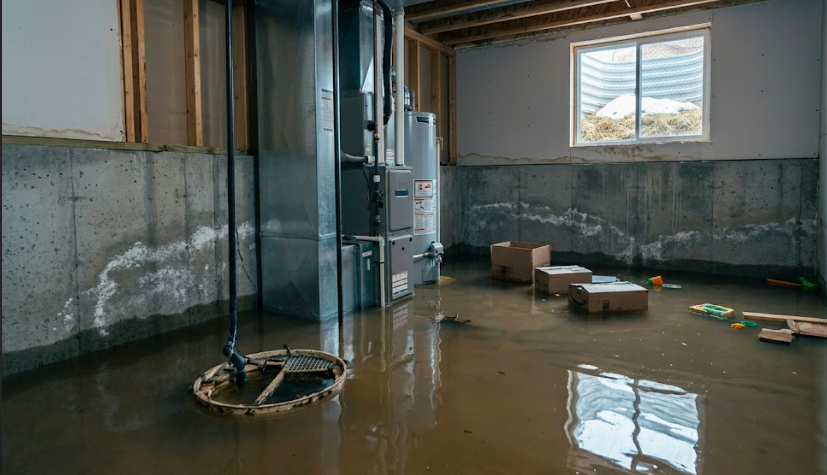
- 3Window well overflow — Window wells are designed to drain slowly into the surrounding soil. Post-fire hydrophobic soil eliminates that drainage capacity entirely. During heavy rain, window wells fill in minutes and admit water through window seals not designed for submersion.
- 4Slab-on-grade cracks and control joints — Homes built on slab foundations common in Southern California experience upward water pressure through control joints and hairline cracks. Flooring materials (carpet, hardwood, LVP) directly bonded to the slab become saturated from below, often without visible surface water.
- 5HVAC condensate line backflow and roof-drain overflow — Debris-choked roof drains and gutters redirect water toward fascia boards and soffit vents during extreme runoff events. Once inside the attic, water follows the path of least resistance into wall cavities arriving at the floor level with no visible ceiling or wall staining to signal its presence.
Detecting hidden post-fire water damage: what you can check vs. what requires a professional
| Warning Sign | What It Likely Indicates | DIY-Detectable? | Professional Tool Needed |
|---|---|---|---|
| Musty odor in basement or crawl space | Active mold growth on porous materials | Yes (smell) | Moisture meter, air quality test |
| Soft or spongy flooring near exterior walls | Subfloor saturation, likely ongoing | Partially | Moisture probe meter, thermal camera |
| White efflorescence on foundation walls | Prior water intrusion depositing mineral salts | Yes (visual) | Structural assessment for active seepage |
| Paint bubbling or drywall soft spots | Moisture trapped behind wall surface | Yes (visual) | Pin-type moisture meter, thermal imaging |
| Hardwood floor cupping or gapping | Moisture imbalance — likely subfloor or slab moisture | Yes (visual) | Wood moisture content meter (target ≤12%) |
| Dark staining at base of drywall | Wicking from floor-level water intrusion event | Yes (visual) | Moisture meter to confirm active vs. historical |
| No visible signs, but home is in post-fire zone | Possible Phase 1 ash infiltration or Phase 3 hidden moisture | No | Thermal imaging + air sampling required |
What Midwest and Ohio homeowners need to understand: the parallel risk you’re not talking about
If you live in California, the connection between wildfire and water damage is viscerally obvious. But the underlying physics overwhelmed drainage, rapid surface runoff, foundation pressure, and hidden structural moisture play out every year in Ohio and across the Great Lakes region under entirely different trigger conditions.
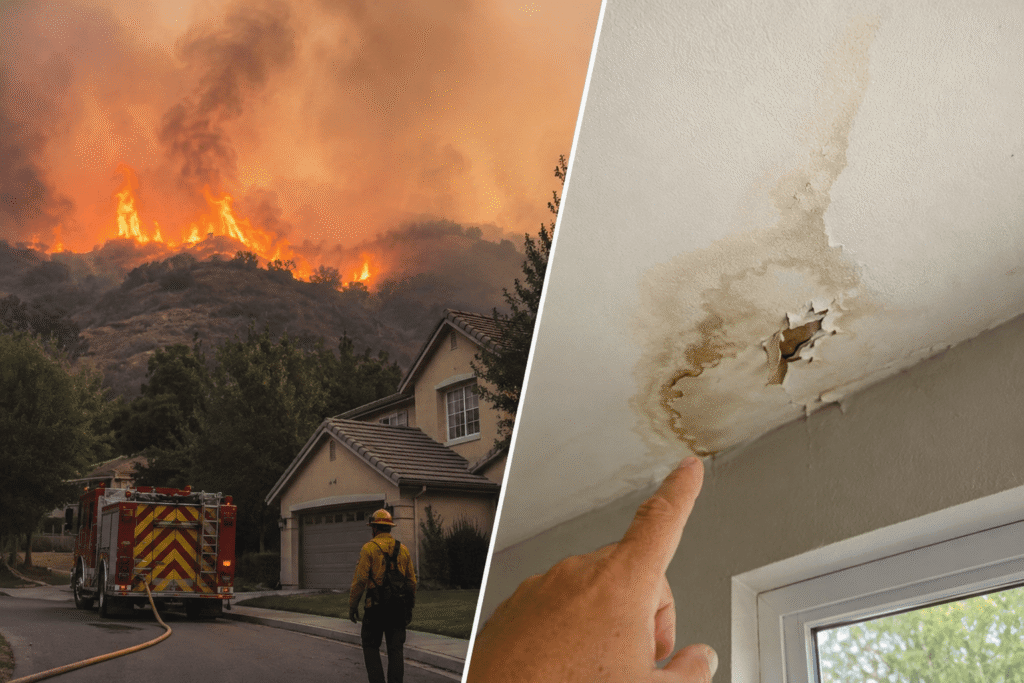
Northeast Ohio’s clay-heavy glacial soil functions like post-fire hydrophobic soil during spring snowmelt events. When frozen ground thaws from the top down, the upper soil layer becomes saturated while lower layers remain frozen and impermeable. Meltwater cannot infiltrate downward it sheets across the surface, toward foundations, window wells, and storm drains, in exactly the same pattern as post-fire runoff in California.
Ohio’s three water damage triggers that mirror post-wildfire flooding
| Trigger | California Post-Wildfire Equivalent | Ohio Season | Typical Damage |
|---|---|---|---|
| Spring snowmelt on frozen ground | Rain on hydrophobic burn scar | March – April | Basement flooding, foundation seepage |
| Freeze-thaw foundation crack expansion | Post-fire soil settlement cracking | Nov – March | Active foundation cracks, water entry |
| Summer storm overwhelm of clay soil | First post-fire rainstorm | June – August | Rapid surface flooding, sump failure |
| Sump pump failure during power outage | Drainage infrastructure overwhelm | Year-round | Finished basement inundation |
The hidden moisture problem is identical regardless of the trigger
Whether water enters your Ohio home during a March snowmelt event or a California home during a post-fire rainstorm, the structural behavior of water in building materials is identical. Drywall absorbs moisture. Subfloor lumber swells. Insulation compresses and loses R-value. Mold colonizes porous surfaces within 48 hours.
The critical difference between a $3,000 restoration job and a $12,000 one is always the same variable: how quickly professional extraction and drying begins. Every hour of delay allows water to migrate further into structural materials moving from Class 1 (surface wet) to Class 4 (deep structural saturation) and from Category 1 (clean) to Category 3 (contaminated) as microbial activity increases.
For homeowners in the greater Akron area dealing with any of these seasonal water intrusion events, water damage restoration in Akron, OH from an IICRC-certified team provides the same industrial extraction, thermal imaging assessment, and documented drying log that California restoration professionals use for post-fire water events because the protocols are standardized nationally under IICRC S500, regardless of what triggered the water intrusion.
Three Ohio-specific prevention actions for high-risk spring seasons
- Install a sump pump battery backup before March. The peak snowmelt flooding window in Northeast Ohio coincides with spring storms that cause power outages. A battery backup prevents the cascading failure where the pump goes offline exactly when water volume peaks.
- Pre-season foundation crack inspection. Freeze-thaw cycling widens micro-cracks incrementally every winter. Cracks that held last year may admit water this spring. A pre-season hydraulic cement or epoxy injection on active cracks costs $400–$900 and prevents a $6,000+ finished basement event.
- Clear downspout extensions before snowmelt. Frozen or debris-blocked downspout extensions direct roof runoff directly against foundation walls during the highest-volume melt events. Extending downspouts a minimum of 6 feet from the foundation is one of the highest-ROI prevention measures available.
Post-fire and high-runoff water damage: how risk profiles compare across US climate zones
| Climate Zone | Primary Water Damage Trigger | Soil Behavior | Dominant Damage Type | Peak Season |
|---|---|---|---|---|
| Southern California | Post-wildfire rain on hydrophobic burn scars | Rocky, fast-draining → hydrophobic after fire | Debris flow, slab intrusion, Cat 3 contamination | Oct – Feb |
| Pacific Northwest | Atmospheric rivers on saturated soil | Sandy loam, high capacity but easily overwhelmed | Crawl space flooding, basement seepage | Nov – Mar |
| Southeast (GA, FL, SC) | Hurricane and tropical storm flooding | Sandy to loamy — rapid saturation | Storm surge, roof intrusion, mold acceleration | Jun – Oct |
| Great Lakes / NE Ohio | Snowmelt on frozen/clay soil | Heavy clay — slow infiltration, pools rapidly | Basement flooding, foundation crack pressure | Mar – Apr |
| Central Plains | Severe storm and tornado rain events | Mixed — loam to clay, varies by state | Flash flooding, sump pump failure | Apr – Jun |
| Midwest (IL, IN, MI) | Combined snowmelt + spring storms | Clay-heavy — mirrors NE Ohio behavior | Basement flooding, subfloor saturation | Mar – May |
| IICRC S500 response protocols apply equally across all zones — regardless of trigger, the structural behavior of water in building materials is identical. | ||||
The insurance coverage gap that affects every homeowner in this guide
Whether you’re in a California wildfire flood zone or an Ohio spring melt zone, the same insurance gap applies and most homeowners discover it at the worst possible moment.
Standard homeowners insurance (HO-3 form) covers sudden and accidental water damage from internal sources. It does not cover:
- Flooding that enters from the ground or through the foundation (requires separate NFIP or private flood policy)
- Post-wildfire debris flow (typically classified as flood by insurers)
- Gradual leaks or seepage not reported promptly
- Sewer or drain backup without a specific endorsement
According to the Insurance Information Institute, only about 4% of US homeowners in high-risk flood areas carry flood insurance despite flood damage being one of the most costly and common events affecting those zones.
What to do if you suspect post-wildfire or post-storm hidden water damage
The action sequence is the same regardless of whether your trigger was a California burn scar or an Ohio spring melt. Speed is the only variable that meaningfully controls total cost and scope.
- 1Do not wait for visible signs. Thermal imaging and moisture meters reveal hidden moisture that will never be visible until it’s a mold remediation job. If your home experienced any of the entry-point scenarios described above, treat it as confirmed water intrusion until a professional assessment rules it out.
- 2Photograph everything before touching anything. Insurers require documentation of the original damage state. This includes every affected surface, every water entry point, and any exterior drainage conditions that contributed to the event.
- 3Call a certified IICRC restoration team not a general contractor. Post-fire water events involve contaminated water that requires category-specific protocols. A general contractor with fans and shop vacs is not equipped for Category 2/3 events and will not produce the drying logs required for an insurance claim. Verify IICRC certification at iicrc.org/consumers before authorizing any work.
- 4Request a moisture mapping report on day 1. This is a thermal imaging sweep and moisture reading log of the entire affected area. It establishes the baseline for your restoration and becomes part of your insurance claim package. Without it, you have no proof of what was wet and what the starting point was.
- 5Do not sign a Certificate of Completion until moisture readings confirm structural dryness. Every affected material must test at or below IICRC S500 moisture thresholds before drying equipment is removed. Premature signoff is the leading cause of post-restoration mold development and it voids most contractor warranties.
- 6For Ohio homeowners: schedule your pre-spring inspection. The best time to assess your home’s vulnerability is before the March–April melt window, not during it. A pre-season assessment identifies active foundation cracks, sump pump status, and downspout drainage the three highest-risk variables for spring flooding events.
Frequently asked questions
Does homeowners insurance cover water damage from post-wildfire flooding?
In most cases, no. Post-wildfire flooding is typically classified as a “flood” event by insurers, which means it requires a separate flood insurance policy through FEMA’s NFIP or a private insurer. Standard HO-3 homeowners policies cover water damage from internal sources (burst pipes, appliance failures) but explicitly exclude ground-entry flooding. If you are in or adjacent to a fire-affected area, contact your insurer immediately to clarify your coverage before the next rain event and note that NFIP policies have a mandatory 30-day waiting period before coverage activates.
How long after a wildfire should I be concerned about water damage risk?
According to USGS post-fire research, hydrophobic soil conditions and elevated debris flow risk typically persist for two full rainy seasons after a wildfire roughly 18–24 months. During this window, even moderate rainfall events can produce runoff volumes that far exceed pre-fire norms. Homeowners in adjacent (non-burned) areas should maintain this elevated vigilance for the same period.
If ash got into my HVAC after a nearby fire, what should I do?
Ash from structure fires contains heavy metals, PAHs, and other hazardous compounds. Do not run your HVAC system until a professional inspection and cleaning is performed running a contaminated system distributes fine particulates throughout every room. Replace all air filters immediately. An air quality professional can test indoor air for PM2.5 (fine particulates) and VOCs to determine the contamination level. HEPA air scrubbers used during water damage remediation are also effective for post-fire air quality restoration.
How is post-wildfire water damage different from regular flood damage in terms of restoration?
In two significant ways. First, the contamination level is higher post-fire runoff is classified as Category 3 (grossly contaminated) under IICRC S500, meaning all porous materials that were contacted must be removed and disposed of, not dried and saved. Second, the ash residue creates ongoing hygroscopic moisture retention in building materials, extending the remediation timeline and requiring air scrubbing alongside standard water extraction. Standard flood damage from clean rainwater is often Category 1 or 2, with more salvageable materials.
Is the water damage risk from Ohio spring flooding really comparable to California post-fire flooding?
In terms of structural impact and restoration protocols, yes though the causes differ significantly. Both events overwhelm a soil’s normal infiltration capacity and direct high volumes of water toward foundations under elevated hydrostatic pressure. The contamination level is typically lower in Ohio snowmelt events (often Category 1 or 2 vs. Category 3 for post-fire events), but the structural entry mechanisms, drying requirements, and mold risk timelines are governed by the same IICRC S500 standards. The restoration response should be equally urgent.
The bottom line: the trigger is different, the response is identical
Whether it’s a California hillside stripped bare by wildfire or an Ohio clay-soil neighborhood in the grip of its fifth freeze-thaw cycle of winter, the water damage story ends in the same place: water in places it shouldn’t be, in building materials that were never designed to be wet, with a mold clock ticking from the first hour of contact.
The homeowners who come out of these events with the smallest bills and the least disruption are the ones who understood three things before the water arrived: how their home’s specific vulnerabilities work, what their insurance actually covers, and who to call in the first two hours.
In California, that means having a certified restoration contractor’s number before the first post-fire rain warning drops. Our team at Wise Tools Water Damage Restoration serves the Hollywood and greater Los Angeles area for exactly these events call us at the first sign of water intrusion.
For homeowners in the Great Lakes and Northeast Ohio region facing the spring melt season, the same urgency applies. The team providing water damage restoration in Akron, OH operates with the same IICRC-certified protocols, the same thermal imaging assessments, and the same insurance-grade documentation that any professional post-fire restoration would require because water damage is water damage, regardless of what put it in your walls.
The 48-hour mold window doesn’t care how the water got there. Neither should you.
Leave a Reply